INDIAN AGNI MISSILE
It is surface-to-surface missile (SSM) or ground-to-ground missile (GGM) is a missile designed to be launched from the ground or the sea and strike targets on land or at sea.
Agni- I
Agni Missile is an Intermediate Range Ballistic Missile.
Agni-I used solid propulsion booster and a liquid propulsion upper stage,
derived from Prithvi, essentially to prove the re-entry structure, control and
guidance. The strap-down inertial navigation system adopts explicit guidance,
which has attempted for the first time in the world. The Agni-1 is 14.8 m long,
1.3 m in diameter, with a launch weight of 12,000 kg. It has a range of 700 km
with an accuracy of 25 m CEP at a range of 860 km. At its maximum payload of
2,000 kg,

the missile can carry a 20 or 45 kT nuclear warhead, or conventional explosives. By reducing the payload by half, the Agni-1 could most likely extend its range to 1,200 km, a distance which encompasses all of Pakistan. Payload weight reductions could also be used to include penetration aids. Some suspect that the reentry vehicle also includes liquid propellant side-thrust motors to add a degree of maneuverability to avoid defenses. The Agni-1 is designed to be launched from Transporter-Erector-Launcher (TEL) vehicles, either based on road or rail-mobile platforms. In addition, the missile has a relatively high accuracy, due to its combination of an inertial guidance system with a terminal phase radar correlation targeting system on its warhead.It uses all carbon composite structure for protecting payload during its re-entry phase. The first flight conducted in May 1989, established the re-entry technology and precise guidance to reach the specific target. Agni-I flight trials having proved the long-range technologies, an operational version of agni with solid-solid propulsion system was test fired in April 1999, which is Agni-II with mobile capability.
Agni- II
The Agni is a two-stage, medium-range, rail/road-mobile,
solid propellant ballistic missile. Development on the Agni-2 variant missile
began in July 1997 after the original Agni (technical demonstrator) missile
program was canceled in 1996. The Agni-2 borrows heavily from the original
program, though it uses a two-stage solid propellant motor instead of the
liquid propelled second stage motor employed by its predecessor.

The Agni-IIA
is a more advanced version of Agni-II, albeit with more sophisticated and
lighter materials, yielding a better range and operating regime. Agni-IIA was
later renamed as Agni-IV plugging the gap between Agni-II and Agni-III. While
the first test of Agni-IV in December 2010 was a failure, the second test
flight in November 2011 was a success Agni-II, developed as part of medium- and
long-range Agni series of missile systems, has already been inducted into the
Armed Forces.
Agni-III
The Agni-3is an intermediate-range, two-stage solid
propellant ballistic missile. Compared to the original Agni-1 and Agni-2, the
Agni-3 is shorter, wider, and capable of delivering a heavier warhead. Whereas
the Agni-2 is 20 m long, the newer missile is only 16.7 m long. With a width of
1.85 m and a weight of 48,000 kg though, the Agni-3 delivers a heavier warhead
a greater distance.
India's Credible minimum deterrence envisages a nuclear
triad of counter-strike capability which required a long range missile to
provide robust second strike capability.
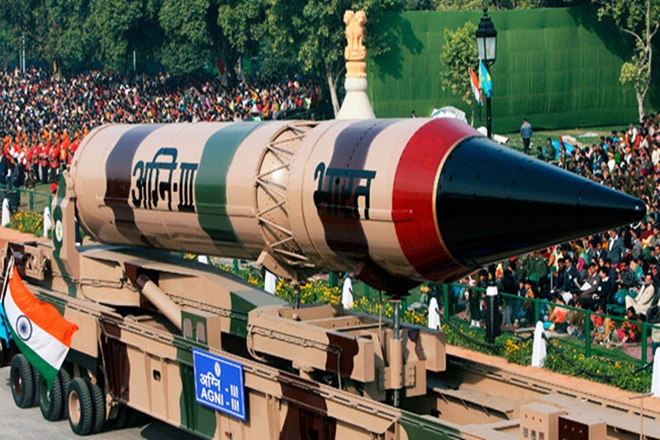
A missile system that can be dispersed
far and wide in the Indian mainland, its far flung islands or its blue water
naval assets dispersed across the world's oceans. Following this necessity
India developed a larger Agni-III missile, with a heavier payload and a longer
range but in a compact configuration, i.e. thicker but shorter length. This
development is driven by need for a more assured retaliation that can defeat
emerging anti ballistic missile (ABM) defence and countermeasures.
Agni-IV
Agni-IV is the fourth in the Agni series of missiles which
was earlier known as Agni II prime. It has been developed by India's DRDO and
displayed a number of new technologies and significant improvement in missile
technology. Early reports about the Agni-4 suggested that it may be a
technology demonstrator between the Agni-3 and the ICBM range Agni-5.

However, after a successful test in January 2014, Indian
Army officials suggested that the missile would enter serial production,
suggesting that it will play a role in the nation’s nuclear arsenal The missile
is light-weight and has two stages of solid propulsion and a payload with
re-entry heat shield.[5] With a 4,000 km (2,500 mi) range, it is capable of
striking targets in nearly all of mainland China (including Beijing and
Shanghai) if launched from northeastern India.
Agni -V
Agni V is primarily for enhancing India’s nuclear deterrence
against China. Until recently, the longest range missile India had was Agni-III
with a range of 3000–3500 km. This range was not sufficient to reach targets on
the extreme eastern and north- eastern region of China. Most of the important
economic centres of China lay on its eastern sea board. Agni-V is an
intercontinental ballistic missile developed by the Defence Research and Development
Organisation (DRDO) of India.
Agni V is part of the Agni series of missiles,
one of the missile systems under the original Integrated Guided Missile
Development Program. The DRDO chief V.K. Saraswat initially declined to
disclose the exact range of Agni-V. Later, however, he described Agni V as a
missile with a range of 5,500–5,800 km. Du Wenlong, a researcher at China’s PLA
Academy of Military Sciences, told the Global Times that the missile has a
range of around 8,000 kilometres Senior
defence scientist M. Natrajan disclosed in 2007 that DRDO was working on an
upgraded version of the Agni III, known as the Agni-V, and that it would be
ready in 4 years. The missile was to have a range of more than 5,000 kilometres .
AGNI- IV
New Delhi, Nov 8: Agni 5 is
India's most advanced missile and it has been inducted into the service after
successive trials. After Agni 5 project ended, there were speculations that the
DRDO may have begun working on an ICBM with longer range and payload carrying capabilities.
Many reports have claimed that the DRDO a three-stage Agni VI missile. India
has not made any clear statement on the development of Agni 6 which, many
opine, may have range between 8,000 km to 10,000 km. DRDO usually has a
development gap between each Agni-series of around 4-5 years.
It has been over 5 years since
Agni-V was developed and this has led to speculation that its successor could
be ready. Agni 6 could be a three-stage solid fuel ICBM missile which will be
heavier and thicker thanthe Agni-V. Agni-VI could possibly be able to carry 3
tonne warheads thrice that of Agni-V which can carry only 1.1 Tonne warheads.
Agni-VI will be the first missile to have the
AGNI MISSILE SPECIFICATIONS
S.NO
|
AGNI MISSILE
|
I
|
II
|
III
|
IV
|
V
|
VI
|
1
|
Type
|
Short
Range Ballistic Missile
|
Medium
Range Ballistic Missile
|
Intermediate
Range Ballistic Missile
|
Intermediate
Range Ballistic Missile
|
Intercontinental
ballistic missile
|
ICBM
development
Progress
|
2
|
Place
of origin
|
India
|
India
|
India
|
India
|
India
|
India
|
3
|
Used by
|
India
army
|
India
army
|
Strategic
Forces Command
|
(SFC)
|
(SFC)
|
(SFC)
|
4
|
Designer
|
Defence
Research and Development Organisation (DRDO)
|
DRDO
|
DRDO
|
DRDO
|
DRDO
|
DRDO
|
5
|
Manufacturer
|
Bharat
Dynamics Limited
|
BDL
|
BDL
|
BDL
|
BDL
|
BDL
|
6
|
Mass
|
12,000kg
|
16,000
kg
|
50,000KG
|
17,000
kg
|
50,000kg
|
55,OOO
to 70.000kg
|
7
|
Length
|
15m
|
21m
|
17m
|
20m
|
17.5m
|
20 to
40m
|
8
|
Diameter
|
1.0m
|
1.3m
|
2.0m
|
2m
|
2m
|
2m
|
9
|
Warhead
|
1,000-2,500
kg
Strategic
nuclear weapon (15 kt to 250 kt),
|
1,000
kg Strategic nuclear weapon
|
2000 to
2500 kg Strategic nuclear weapon
|
(~15 to
250 kilotonnes Strategic nuclear weapon
|
1,500
kg (1.5 ton)
Strategic
nuclear weapon
|
3000kg
Strategic nuclear weapon
|
10
|
Engine
|
Single
Stage, Solid fuel
|
Two-and-half-stage
solid propellant engine
|
Two
stage solid propellant engine
|
Two
stage solid propellant engine
|
Three-stage
solid-fuel rocket.
|
development
Progress
|
11
|
Range
|
700 –
900k
|
2,000–3,500
km
|
3,500
km – 5,000 km
|
4000km
|
5000 to
8000km
|
8000 to
12,000km
|
12
|
Flight
ceiling
|
370km
|
405km
|
>
450 km
|
900km
|
-
|
development
Progress
|
13
|
Speed
|
2.5km/s
|
3.9
km/s
|
5 –
6km/s
|
Mach 24
|
||
14
|
Accuracy
|
25m CEP
|
30–40 m
CEP
|
40 m
CEP
|
less
than 100 m CEP
|
10-80 m
CEP
|
development
Progress
|
15
|
No.
built
|
12 At
2017
|
12 At
2017
|
-
|
-
|
-
|
|
16
|
platform
|
8 x 8
Tatra
TELAR
(Transporter erector launcher)
|
8 x 8
Tata TELAR (Transporter erector launcher) Rail Mobile Launcher
|
8 × 8
TELAR (Transporter erector launcher) Rail Mobile Launcher
|
8 x 8
TELAR (Transporter erector launcher) Rail Mobile Launcher
|
8 × 8
Tatra TEL and rail mobile launcher (canisterised missile package)
|
Road
mobile
|
17
|
Guidance
system
|
Ring
Laser Gyro- INS (Inertial Navigation System), optionally augmented by GPS
terminal guidance with possible radar scene correlation
|
ring
laser gyroscope- INS (Inertial Navigation System), optionally augmented by
GPS terminal guidance with possible radar scene correlation
|
Ring
Laser Gyro- INS (Inertial Navigation System), optionally augmented by GPS,
terminal guidance with possible radar scene correlation
|
Ring
Laser Gyro - INS (Inertial Navigation System), optionally augmented by
GPS/IRNSS. Terminal guidance with possible radar scene correlation[citation
needed]
|
Ring
laser gyroscope and inertial navigation system, optionally augmented by
GPS/IRNSS
|
development
Progress
|
Unit
cost
|
₹25–35
crores
|
₹250 TO
₹350 million
|
-
|
₹50
crore
|
development
Progress
|
gni 5 missile testing


No comments:
Post a Comment