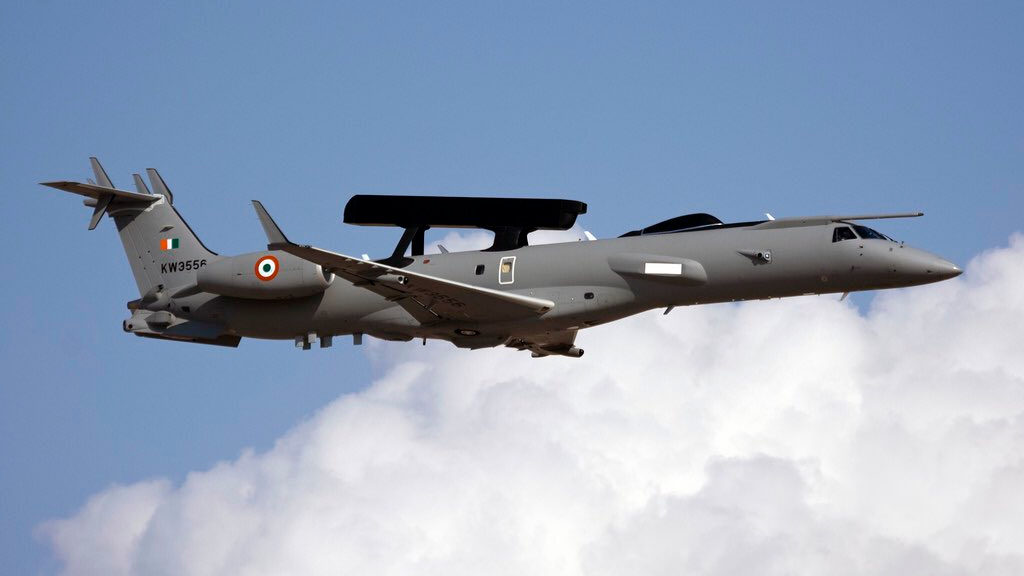
DRDO developed a multisensor airborne early
warning and control (AEW&C) system on a carrier jet, providing an airborne
surveillance system in collaboration with CAB (Centre for Airborne Systems) for
the Indian Air Force. It is the first native AEW system developed by DRDO and
CAB. It was completely developed and built using the native technology
platform, EMB-145. The AEW&C system is developed to serve the Indian Air Force
in detection and tracking, identification and classification of threats,
guidance and interception control, display of air situation picture and
multisensor data integration. The system enables the armed forces to
communicate with fighter jets and other AEW&C assets, while it also allows
for Search and Rescue (SAR) operations, mission planning as well as record and
replay for post mission analysis.

An airborne
early warning and control (AEW&C) system is an airborne radar picket system
designed to detect aircraft, ships and vehicles at long ranges and perform
command and control of the battlespace in an air engagement by directing
fighter and attack aircraft strikes. AEW&C units are also used to carry out
surveillance, including over ground targets and frequently perform C2BM
(command and control, battle management) functions similar to an Air Traffic
Controller given military command over other forces. When used at altitude, the
radar on the aircraft allows the operators to detect and track targets and
distinguish between friendly and hostile aircraft much farther away than a
similar ground-based radar. Like a ground-based radar, it can be detected by
opposing forces, but because of its mobility, it is much less vulnerable to
counter-attack.
AEW&C aircraft are used for both defensive
and offensive air operations, and are to the NATO and US forces trained or
integrated Air Forces what the combat information center is to a US Navy
warship, plus a highly mobile and powerful radar platform. The system is used
offensively to direct fighters to their target locations, and defensively,
directing counterattacks on enemy forces, both air and ground. So useful is the
advantage of command and control from a high altitude, the United States Navy
operates Northrop Grumman E-2 Hawkeye AEW&C aircraft off its Supercarriers to
augment and protect its carrier Command Information Centers. The designation
airborne early warning (AEW) was used for earlier similar aircraft, such as the
Fairey Gannet AEW.3 and Lockheed EC-121 Warning Star, and continues to be used
by the RAF for its Sentry AEW1, while AEW&C (airborne early warning and
control) emphasizes the command and control capabilities that may not be
present on smaller or simpler radar picket aircraft. AWACS (Airborne Warning
and Control System) is the name of the specific system installed in the E-3 and
Japanese Boeing E-767 AEW&C airframes, but is often used as a general
synonym for AEW&C.
AEW&C system platform details.
Two radiating planar arrays assembled
back-to-back and mounted on top of the fuselage in an active antenna array unit
(AAAU) will provide 240° coverage like Erieye. The AAAU is configured to
compactly house 10 × 2 antenna array panels, 160 transmit receive 10 × 2
antenna array panels, 160 transmit receive multi-modules (TRMMs) dividers, beam
forming units, beam control units, power supply units and related electronic
devices including cables and connectors. This has been achieved through an
innovative and iterative process to arrive at the AAAU with minimal dimensions
and optimum mass properties. A unique feature of this Indian TRMM design is
that eight trans-receive modules are combined compactly to form a single TRMM,
thus facilitating high density installation of 160 of them in the AAAU to power
the surveillance radar.
The jet platform
selected for the DRDO AEW&C system is the Embraer EMB-145 from Brazil. The
jet is modified to integrate mission systems. The cabin is also modified to
house five operator work stations, four racks, additional fuselage fuel tanks
and five rest crew seats. The modified aircraft has additional power unit to
power onboard mission systems. It can also support the in-flight re-fuelling
system for extended endurance of the mission. Two radiating planar arrays are
mounted above the fuselage of the EMB-145 to provide 240° coverage. The arrays
are fixed in back-to-back arrangement in an active antenna array unit (AAAU). The
AAAU is designed to fit 10×2 antenna array panels, 160 Transmit Receive Multi
Modules (TRMM) and all the supporting devices, including power supply units and
control units. Each TRMM is made of eight compactly fused transmit receive
modules to ensure high density installation of 160 TRMMs.
Orders and deliveries of DRDO’s AEWCS
The Government
of India approved the AEWCS programme after the Indian Air Force (IAF) and
Defence Research and Development Organisation (DRDO) jointly studied the
feasibility of the AEWCS. Three EMB-145s were ordered by the Indian Government.
The indigenous radar system of the DRDO was integrated after the aircraft was
modified accordingly. The first aircraft AEW&C platform developed for India
was unveiled at Embraer’s headquarters in São José dos Campos in February 2011.
The fully modified aircraft equipped with Active Electronic Scanning Array
(AESA) radar and other electronic payloads made its first flight in December
2011 at Embraer’s facilities. It incorporated more than 1,000 mission system
components manufactured by DRDO.
Embraer
delivered the first fully modified EMB-145 aircraft to accommodate the Indian
AEWCS in August 2012. The company delivered two of three modified EMB-145s to
DRDO in 2012. The two aircraft were installed with the native AEW&C system
for mission system testing.
Capabilities
- The AEWACS aircraft will have an active electronically scanned array (AESA) primary radar with IFF. The system will also have ESM (Electronic Support Measures) and CSM (Communications Support Measures) ability. Datalinks to network the AEWACS with fighters, and ground-based control systems will also be provided, as will be the SATCOM (Satellite Communication System). The aircraft will also have a comprehensive self-defence suite. The avionics suite will be linked via a datahandling system, controlled by Mission computers.
- The Radar will have an extended range mode against fighter aircraft, and will consist of two back to back AESA arrays, with an additional dedicated IFF array.
- The ESM system will be able to track sources with a directional accuracy of 2 deg. RMS and a frequency accuracy of 1 MHz.
- The ESM system will have complete 360 degree coverage in azimuth and have a database of up to 3000 emitters against which threats will be scanned.
- Communication Support Measure system will analyse and record intercepted communications both inflight and post flight.
- Self Protection Suite will have a passive Missile Approach Warning System, a Radar Warning Receiver and countermeasures dispensers. The SPS will be integrated with the ESM and CSM suite.
- The aircraft will support Inflight refuelling.
- The aircraft will have SATCOM, and datalinks to pass on ESM, CSM and radar data to ground stations and datalinks to pass on target information to fighters. More than 40 other aircraft will be datalinked together by the AEW&C aircraft.
Future Development
DRDO and the
Bengaluru-based Centre for Air Borne Systems (CABS) launched a new project to
build larger and more capable AWACS. Initially, two AWACS aircraft were to be
developed, with four more to follow at a later stage. Clearances for the
project were received from the government in January 2013, and in March 2015 a
decision was made to purchase two Airbus A330s, which was expanded to six
planes in February 2017; the planes will also double as aerial refuelers.


No comments:
Post a Comment