India most powerful air-superiority fighter jet Dassault Rafale
Dassault Aviation is a French
aerospace company that shapes the future by designing and building military aircraft,
business jets and space systems. Designer and builder of the Rafale, a twin-
engine multirole fighter that performs all types of combat missions for both air
forces and naval air arms. Designer of the nEUROn combat drone, built by a
European team, and a leading player in Europe’s future air combat systems. Designer
and builder of the Falcon family of business jets, recognized for their
handling qualities, operational flexibility, low fuel consumption and
innovative solutions. Designer and builder of Falcons modified to carry out maritime
surveillance, intelligence, medical evacuation and other special missions. The
hub of a strategic industrial network comprising hundreds of companies in
France and international markets. Core shareholder in the Thales Group. Expertise
in a number of technologies that are key to national sovereignty. Pioneer in
digital technologies and behind CATIA™, the 3D CAD / CAM system that has become
a global standard. Creator of more than 100 prototypes in the last century, with
over 10,000 aircraft delivered to 90 countries.

Rafale is a twin-jet combat
aircraft capable of carrying out a wide range of short and long-range missions,
including ground and sea attacks, reconnaissance, high-accuracy strikes and
nuclear strike deterrence. The Dassault Rafale is a French twin-engine, canard
delta wing, multirole fighter aircraft designed and built by Dassault Aviation.
Equipped with a wide range of weapons, the Rafale is intended to perform air
supremacy, interdiction, aerial reconnaissance, ground support, in-depth
strike, anti-ship strike and nuclear deterrence missions. The aircraft were
developed for the French Air Force and Navy.

The Rafale entered service with
the French Navy in 2004 and the French Air Force in 2006. Ten aircraft are
operational on the Charles de Gaulle aircraft carrie The State of Qatar signed
a contract with Dassault Aviation to acquire 24 Rafale fighters in May 2015.
The $7bn contract also includes an option for 12 additional fighters and the
option was exercised by Qatar in December 2017. The deliveries of the 36
multirole fighters are expected to start in 2019.
SPECIFICATIONS
S.NO
|
TYPES
|
PARAMETERS
|
1
|
Role
|
Multirole fighter
|
2
|
National origin
|
France
|
3
|
Manufacturer
|
Dassault Aviation
|
4
|
Number built
|
175 (as of January 2019)
|
5
|
Program cost
|
62.7 billion
|
6
|
Crew
|
1 to 2
|
7
|
Length
|
15.27m
|
8
|
Wingspan
|
10.80 m
|
9
|
Height
|
5.34m
|
10
|
Wing area
|
45.7m
|
11
|
Empty weight
|
10,300 kilograms (B)
9,850 kilograms (C)
10,600 kilograms (M)
|
12
|
Loaded weight
|
15,000 kilograms
|
13
|
Max. takeoff weight
|
24,500 kilograms (B/C/D)
|
14
|
Fuel capacity
|
4,700 kg internal for single-seater (C); 4,400 kgfor two-seater (B)
|
15
|
Powerplant
|
2 × Snecma M88-2 turbofans
|
16
|
Dry thrust
|
50.04 kN each
|
17
|
Thrust with afterburner
|
75 kN each
|
18
|
Maximum speed
|
Mach 1.8 (1,912 km/h)
|
19
|
Low altitude
|
: Mach 1.1 (1,390 km/h)
|
20
|
Range
|
>3,700km with drop tanks
|
21
|
Service ceiling
|
15,235 m
|
22
|
Rate of climb
|
>304.8 m/s
|
23
|
Wing loading
|
328 kg/m2
|
24
|
Thrust/weight
|
0.988 (100% fuel, 2 EM A2A missile, 2 IR A2A missile) version B
|
25
|
Armament
|
Guns: 1× 30 mm (1.2 in) GIAT 30/M791 autocannon with
125 rounds
|
26
|
ardpoints
|
14 for Air Force versions (Rafale B/C), 13 for Navy version
|
27
|
Air to Air Missiles
|
Magic II
MBDA MICA IR or EM
MBDA Meteor (planned)
|
28
|
Air-to-ground
|
MBDA Apache
MBDA Storm Shadow/SCALP-EG
AASM-Hammer (SBU-38/54/64)
GBU-12 Paveway II, GBU-22 Paveway III, GBU-24 Paveway III, GBU-49
Enhanced Paveway II
AS-30L
Mark 82
|
29
|
Air-to-surface
|
MBDA AM 39-Exocet anti-ship missile
|
30
|
Nuclear Deterrence
|
ASMP-A nuclear missile
|
31
|
Avionics
|
Thales RBE2-AA AESA radar
Thales SPECTRA Electronic Warfare system.
32Thales/SAGEM-OSF Optronique Secteur Frontal
infra-red search and track (IRST) system
|
orgin
In 1979, the French company
Dassault joined the European Collaborative Fighte project which was renamed the
"European Combat Aircraft". The French company contributed the
aerodynamic layout of a prospective twin-engine, single-seat fighter; however,
the project collapsed in 1981 due to differing operational requirements of each
partner country. In 1983, the Future European Fighter Aircraft programme was initiated, bringing together
Italy, Spain, West Germany, France and the United Kingdom to jointly develop a
new fighter, although the latter three had their own aircraft developments.
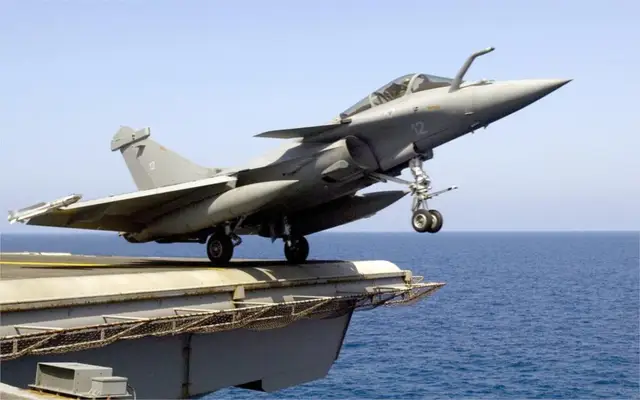
The Rafale, a fully “Omnirole” fighter, is available in three variants.
they are
1. the Rafale C single-seater operated from land bases,
2.the Rafale M single-seater for carrier operations,
3. the Rafale B two-seater flown from land bases.
1. the Rafale C single-seater operated from land bases,
2.the Rafale M single-seater for carrier operations,
3. the Rafale B two-seater flown from land bases.
All three variants share a common
airframe and a common mission system, the differences between naval and land
versions being mainly limited to the undercarriage and to the arresting hook.
OMNIROLE BY DESIGN.
When the Rafale programme was
launched, the French Air Force and French Navy published a joint requirement
for an omnirole aircraft that would have to replace the seven types of combat
aircraft then in operation.
The new aircraft would have to be
able to carry out a very wide range of missions.
1. Air-defense
/ air-superiority,
2. Anti-Access/Aera Denial,
3. Reconnaissance,
4. Close air support,
5. Dynamic Targeting,
6. Air-to-ground precision strike / interdiction,
7. Anti-ship attacks,
8. Nuclear deterrence,
9. buddy-buddy refuelling.
2. Anti-Access/Aera Denial,
3. Reconnaissance,
4. Close air support,
5. Dynamic Targeting,
6. Air-to-ground precision strike / interdiction,
7. Anti-ship attacks,
8. Nuclear deterrence,
9. buddy-buddy refuelling.
These requirements were taken into account from the start of the Rafale’s development, leading engineers to invent an aircraft which goes beyond the needs of each type of mission.
A FULL RANGE
OF ADVANCED WEAPONS
OF ADVANCED WEAPONS
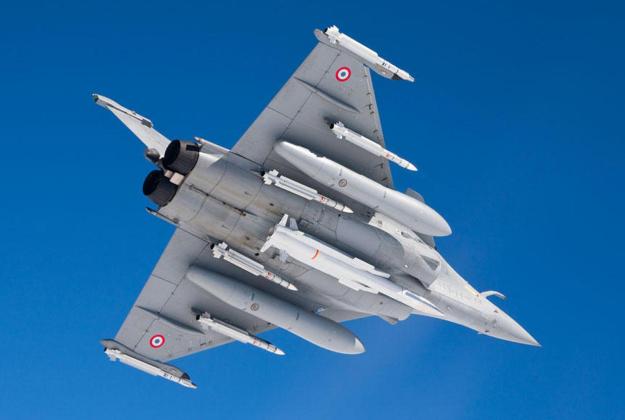
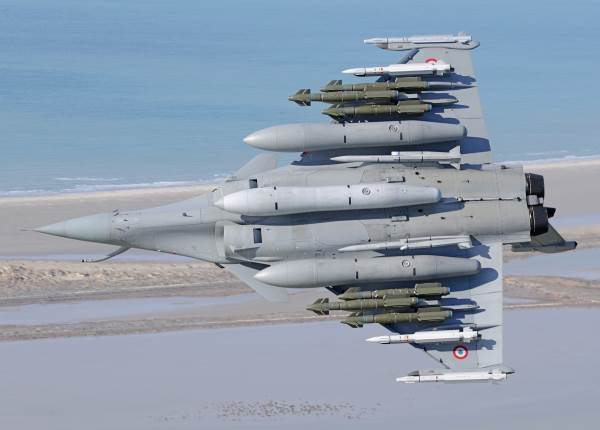
A FULL RANGE OF ADVANCED WEAPONS.
The mission system of the Rafale
has the potential to integrate a variety of current and future armaments.The Rafale has been cleared to
operate the following weapons.
1. The MICA air-to-air “Beyond Visual Range” (BVR) interception, combat and self-defense missiles, in their IR (heat-seeking) and EM (active radar homing) versions. The MICA can be used within visual range (WVR) and beyond visual range (BVR).
2. The HAMMER (standing for Highly Agile and Maneuverable Munition Extended Range) modular, rocket-boosted air-to-ground precision guided weapon series, fitted with INS/GPS or INS/GPS/IIR (imaging infra-red) guidance kits, or with the upcoming INS/GPS/laser guidance kit.
3. The SCALP long-range stand-off missile.
4. The AM39 EXOCET anti-ship missiles
5. Laser-guided bombs,
6. The 2500 rounds/min NEXTER 30M791 30 mm internal cannon, available on both single and two-seater
7. The upcoming METEOR long-range air-to-air missile.
1. The MICA air-to-air “Beyond Visual Range” (BVR) interception, combat and self-defense missiles, in their IR (heat-seeking) and EM (active radar homing) versions. The MICA can be used within visual range (WVR) and beyond visual range (BVR).
2. The HAMMER (standing for Highly Agile and Maneuverable Munition Extended Range) modular, rocket-boosted air-to-ground precision guided weapon series, fitted with INS/GPS or INS/GPS/IIR (imaging infra-red) guidance kits, or with the upcoming INS/GPS/laser guidance kit.
3. The SCALP long-range stand-off missile.
4. The AM39 EXOCET anti-ship missiles
5. Laser-guided bombs,
6. The 2500 rounds/min NEXTER 30M791 30 mm internal cannon, available on both single and two-seater
7. The upcoming METEOR long-range air-to-air missile.
Overview
The Rafale M features a greatly
reinforced undercarriage to cope with the additional stresses of naval
landings, an arrestor hook, and "jump strut" nosewheel, which only
extends during short takeoffs, including catapult launches. It also features a
built-in ladder, carrier-based microwave landing system, and the new fin-tip
Telemir system for syncing the inertial navigation system to external
equipment. Altogether, the naval modifications of the Rafale M increase its
weight by 500 kilograms compared to other variants. The Rafale M retains about
95 percent commonality with Air Force variants including, although unusual for carrier-based aircraft,
being unable to fold its multi-spar wings to reduce storage space. The size
constraints were offset by the introduction of Charles de Gaulle, France's
first nuclear-powered carrier, which was considerably larger than previous carriers,
Foch and Clemenceau.
Engine
French company Safran, which
manufactures the M88 engine of the Dassault Rafale fighter aircraft plans to
increase its thrust from 7.5 tone to nine tons. La Tribune newspaper said
yesterday quoting CEO of Safran, Philippe Petitcolin that, the engine upgrade
in terms of thrust was necessary as the Rafale had grown heavier over the years
due to addition of weapons and other systems. He said that the original thrust
of the Rafale engine was the same since the launch of the French fighter. The
Rafale was designed over two decades ago. However, the upgrade issue had not
been discussed with Dassault Aviation, the Safran CEO added. "It is time
to ask the question whether it is appropriate to launch a study that would
increase the engine thrust. Technically we can do. We are in discussion with
the relevant authorities to see if possible.

The Rafale's glass cockpit was
designed around the principle of data fusion a central computer intelligently
selects and prioritises information to display to pilots for simpler command
and control.
Dassault knows how to make an
aircraft with great looks. Dating back to the 50s, they have designed and
manufactured quite a few beauties. The primary flight controls are
arranged in a hands on throttle and stick compatible configuration, with a
right handed side stick controller and a left handed throttle. As I have grown,
so has my respect and admiration for the design and engineering from other
countries.
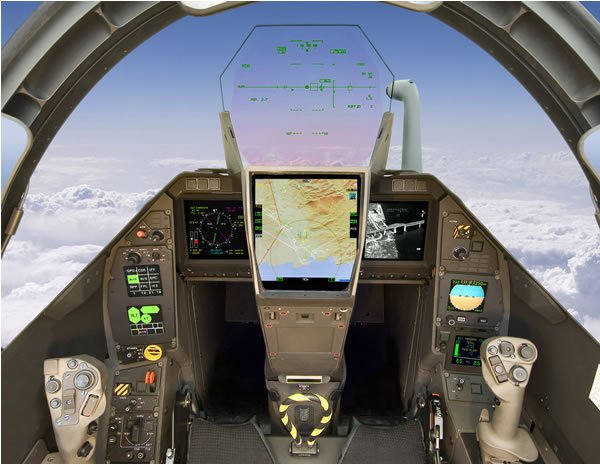
The seat is inclined rearwards at an angle of
29° to improve g-force tolerance during manoeuvring and to provide a less
restricted external pilot view. An intelligent flight suit worn by the pilot is
automatically controlled by the aircraft to counteract in response to
calculated g-forces. Combine a sleek design with 4th and 5th generation
warfighting capabilities and you’ve got a platform that’ll kick your ass while
looking good.
Radar and sensors.
The Rafale was first outfitted with the Thales RBE2 passive
electronically scanned multi-mode radar. Thales claims to have achieved
increased levels of situational awareness as compared to earlier aircraft
through the earlier detection and tracking of multiple air targets for close
combat and long-range interception, as well as real-time

generation of three-dimensional
maps for terrain-following and the real-time generation of high resolution
ground maps for navigation and targeting. In early 1994, it was reported that
technical difficulties with the radar had delayed the Rafale's development by
six months. In September 2006, Flight International reported the Rafale's unit
cost had significantly increased due to additional development work to improve
the RBE2's detection range.

Weapans
1. Air to air missiles
2. Air to ground missiles
3. Air to surface missiles


Why do they show HAL Tejas at the start of this article...?
ReplyDelete