The
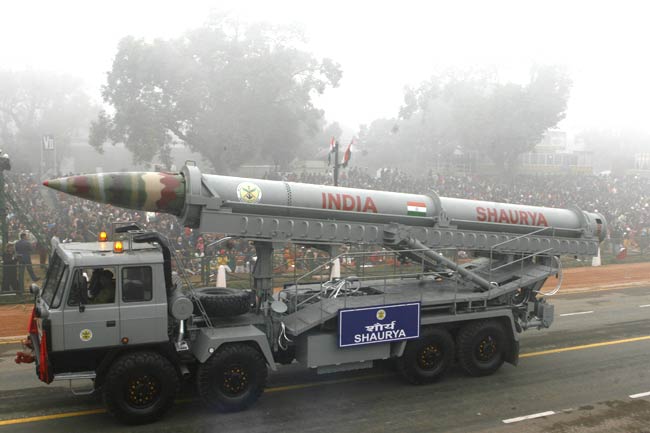
Shaurya missile is a canister launched hypersonic surface-to-surface tactical
missile. And its developed by the Indian Defence Research and Development
Organisation (DRDO) for use by the Indian Armed Forces. These efforts seem to
be bearing fruit though, with India’s first ballistic missile submarine likely
to be inducted into operations in 2016. Work on an Indian SLBM likely began
with the Sagarika or K-15/B-05 program, which has now given way to the K-4 or
Shaurya program. Sagarika’s advanced version, Shaurya is a submarine-launched
medium-range ballistic missile which is 12 m long, 0.8 m wide, uses a two-stage
solid propellant and has a range of 3,000-3,500 km. Its launch weight is 17,000
kg and it can carry a 2,000 kg warhead which is likely to be a nuclear bomb.
With Sagarika and Shaurya, India has completed its nuclear triad.

It has a range
of 700 km (430 mi) and can carry a payload of one ton conventional or nuclear
warhead. It gives the potential to strike in the short-intermediate range
against any adversary.
Sagarika
The Shaurya
missile is speculated to be the land version of the under-water Sagarika K-15
missile, although DRDO officials have reportedly denied its connection with the
K-15 programme Shaurya is stored in a composite canister, which makes it much
easier to store for long periods without maintenance as well as to handle and
transport. It also houses the gas generator to eject the missile from the
canister before its solid propellant motors take over to hurl it at the
intended target. The Sagarika has a maximum range of 700 km and is powered by a
two-stage solid propellant motor. It has a reported length of 10.8 m, a body
diameter of 0.8 m, and a launch weight of 5,500 to 6,300 kg. The payload can be
HE or nuclear with a weight of 500 to 800 kg.

It uses Inertial Navigation
System and Global Positioning System with terrain contour matching in the
terminal phase. Its short range would likely preclude it from being used as a
survivable strike option against China, as it would require the Indian
submarine to be able to launch from the South China Sea. Similarly, the K-15
would also not be able to target Islamabad in Pakistan due to its range
constraints. Because of this limited operational utility, the Sagarika is most
likely an R&D platform for the development of a longer-range SLBM. Between
2004 and 2008, it reportedly underwent 10 different test firings with the first
fully integrated test in January 2010.4
Shaurya
Early testing of
the Shaurya happened on land, with many suggesting that it was the land-based
version of the Sagarika after tests in 2008 and 2011. The missile underwent its
first undersea launch in March 2014 from a submerged barge, also demonstrating
an expanded range of 3,000 km. The missile was tested again, firing at a
depressed trajectory from an undersea barge and allegedly to a range of 3,500
km. Shaurya missiles can remain hidden or camouflaged in underground silos from
enemy surveillance or satellites till they are fired from the special
storage-cum-launch canisters. DRDO scientists admit that given Shaurya's
limited range at present, either the silos will have to be constructed closer
to India's borders or an extended range version will have to be developed.
Defence scientists say the high-speed, two-stage Shaurya is highly manoeuvrable
which also makes it less vulnerable to existing anti-missile defence systems. Shaurya can reach a velocity of Mach 7.5 even
at low altitudes. On 12 November 2008, the missile reached a velocity of Mach 5
as it crossed 300 km, with a surface temperature of 700 °Celsius.
The missile
performed rolls to spread the heat uniformly on its surface. Flight time is
between 500 seconds and 700 seconds. It has been described as a complex system
with high-performance navigation and guidance systems, efficient propulsion
systems, state-of-the-art control technologies and canisterised launch. It can
be easily transported by road and launched by TEL. Technical details on the
Shaurya are difficult to ascertain, as the program is held as a tight secret.
Jane’s estimates that the Shaurya has essentially the same characteristics as
the Sagarika, including the similar short-range, treating the missile as essentially
a ground-launched version. Others have reported that it is longer at about 12
meters and weighs around 17 tons with the ability to carry up to a 2 ton
payload. While Hans Kristensen and Robert Norris suggest that the Indian SLBM
will have to be adjusted to successfully carry the Shaurya,10 others claim that
the missile has already been tested from the Arihant. It is likely that the
missile is intended to carry a nuclear payload to complete India’s nuclear
triad of delivery vehicles and could likely be outfitted with other
conventional payloads.
Shaurya Missile
- Type: Surface-to-surface missile
- Place of origin: India
- Used by: Indian Armed Forces
- Production history
- Manufacturer: Defence Research and Development Organisation (DRDO)
- Produced: 2011
- Mass : 6.2 t
- Length : 10 m
- Diameter: 0.74 m
- Engine Two stage, solid-fueled rocket motors
- Operational range:700 km
- Flight altitude: 40 Km
- Speed: Mach 7.5 (9,187.8 km/h; 2.55218 km/s)
- Guidance system: Ring laser gyro IRNSS 30 m CEP
- Launch platform : Canisterised launch from TEL or underground silo.
India
successfully test-fires Shourya missile.
India's
hypersonic missile, Shourya, was successfully test-fired from the Integrated
Test Range (ITR) at Chandipur on the Orissa coast on Saturday. The missile rose
on the dot at 2.30 p.m. from a canister strapped on to the ground, climbed to
an altitude of 40 km and sped at 7.5 Mach, that is, 7.5 times the speed of
sound. It covered its full range of 700 km in 500 seconds. The
surface-to-surface missile performed a manoeuvre in the closing stages of its
flight and hit the impact point in the Bay of Bengal with an accuracy of a few
metres. A gas generator located at the bottom of the canister pushed the
missile out of the canister, then its first stage ignited and fell off, and the
second stage went into action.
Shourya is the land-variant of India's K-15 missile which is
launched under the water and is being fitted into the Navy's nuclear-powered
submarine, Arihant.


No comments:
Post a Comment