The
use of rockets in India, for warfare, dates to the 18th century. These rockets
(also known as Mysorean rockets) were the first iron-cased rockets that were
successfully deployed for military use. The British reverse-engineered these
and introduced the technology to Europe (see Congreve rocket). When India
became a British colony, scientific R&D in India was restricted and
military science in India naturally lagged. India’s missile arsenal serves a
few purposes in New Delhi’s defense strategy. Fundamentally, its ballistic
missile arsenal is a means to deliver nuclear weapons to deter both Pakistan
and China. The latter requirement has pushed India to develop longer range
missiles and to diversify its delivery platforms beyond mobile land-based
missiles. To this end, India is developing ship- and sub-launched ballistic
missiles and has collaborated with Russia on cruise missile development.

Research in
missile technology resumed again in the late 1950s under the political
leadership of Jawaharlal Nehru, independent India's first prime minister.
Successive Indian government after his, continued providing consistent
political backing to the programme. In 1982, India's political and scientific
leadership, which included prime minister Indira Gandhi, Defence Minister R.
Venkataraman, V.S. Arunachalam (Scientific Advisor to the Defence Minister),
Dr. Abdul Kalam (Director, DRDL) accelerated and gave new dimensions to the
missile programme, under the 'Integrated Guided Missile Development Programme'
(IGMDP). The IGMDP is one of India's most successful defence research project,
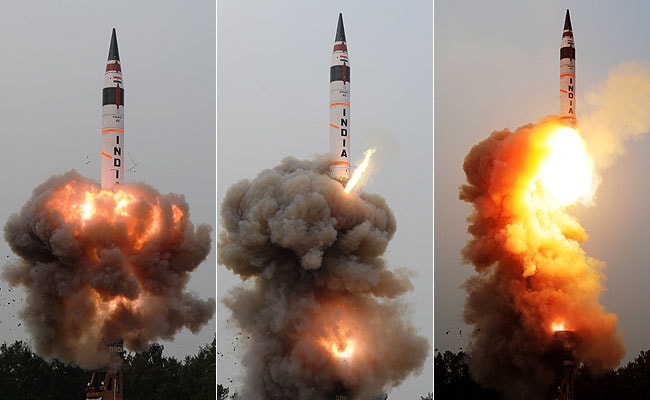
as all the missiles Prithvi, Akash,
Trishul, Nag, Agni – have been successfully tested and inducted by the Indian
armed forces. Ostensibly these developments are all to support India’s minimum
deterrence doctrine, but as their missile arsenal develops, doubts grow about
how firmly they will hew to that doctrine. In particular, the developments of
both canister launched missiles, which can be fired much more quickly, and MIRV
technology, which was often considered a first strike technology during the
Cold War, have raised questions about the future trajectory of New Delhi’s
posture. Still there is little discussion in India about abandoning its
declared no-first-use doctrine, and many of these moves can be thought of as
responses to developments in the Chinese arsenal.
TYPES MISSILES
Missile
|
Class
|
Range
|
News
|
Prithvi-3
|
SRBM
|
300-350 km
|
Operational
|
Prithvi-2
|
SRBM
|
250-350 km
|
Operational
|
Exocet
|
ASCM
|
40-180 km
|
Operational
|
Sagarika/Shaurya
|
SLBM
|
700 km / 3,500 km
|
In Development
|
Prithvi-I
|
SRBM
|
150 km
|
Operational
|
Prahaar
|
SRBM
|
150 km
|
In Development
|
Nirbhay
|
Cruise Missile
|
800-1,000 km
|
In development
|
Dhanush
|
SRBM
|
250-400 km
|
Operational
|
BrahMos
|
Cruise Missile
|
300-500 km
|
Operational
|
Agni-5
|
ICBM
|
5,000-8,000 km
|
In Development
|
Agni-4
|
IRBM
|
3,500-4,000 km
|
In Development
|
Agni-3
|
IRBM
|
3,000-5,000 km
|
Operational
|
Agni-2
|
MRBM
|
2,000-3,500 km
|
Operational
|
Agni-1
|
SRBM
|
700-1,200 km
|
Operational
|
Prithvi missile

Brahmos missile

Nirbhay missiles


No comments:
Post a Comment