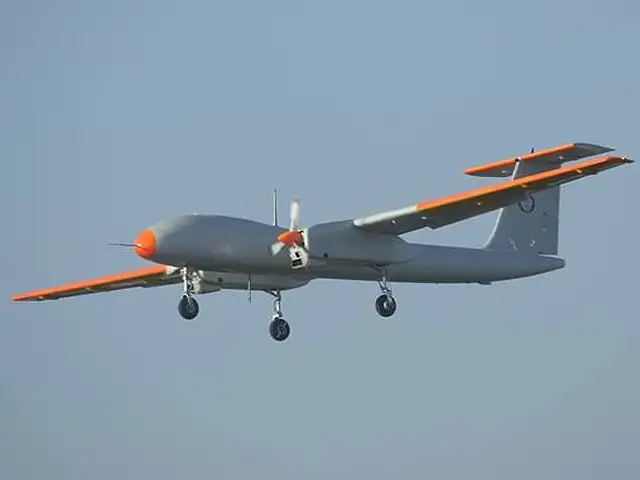
Rustom-1
The
Aeronautical Development Establishment (ADE), DRDO and National Aerospace
Laboratories (NAL) are carrying out advance tests to add the Imperial Eagle,
Rustom-1 and Panchi to the Unmanned Aerial Vehicle (UAV) inventory after
successfully testing the three unmanned vehicles. The Imperial Eagle is a 2-kg
class Mini Unmanned Aerial Vehicle (MUAV) that can fly in divergent weather
conditions.

It is designed to be carried in a soldier’s backpack, be
hand-launched and is recoverable through a soft landing. It is completely
autonomous and can be programmed with navigational waypoints, which can be
changed in-flight by the ground control. With a ground tracker system, it is
capable of providing continuous imagery of the onboard camera, irrespective of
the altitude of the aircraft.4 The MUAV can fly at an altitude of more than 300
m and autonomously cover a range of 7km from the airfield in low cloudy
conditions The Panchi, the wheeled version of the UAV Nishant, became the
latest addition to the family of indigenously developed UAVs after it completed
20 minutes of its maiden flight on December 24, 2014.5 Capable of taking off
and landing using small airstrips, the Panchi gives ‘mission advantage’ to
operators as the turnaround time between sorties can be significantly reduced.
The Panchi has all the surveillance capabilities of the Nishant, but it can
stay in the air longer because it does not have to carry the airbag and
parachute systems of the Nishant. It is also a light vehicle with its body made
of composites and has a high degree of stealth because it has a low radar
cross-section signature.6 Having an endurance of four hours, it can track
ground targets over an area of 165 km. The Rustom-1, the Medium Altitude Long
Endurance (MALE) UAV, underwent a successful endurance flight on September 20,
2014.7 It is one of the three variants of the Rustom UAV, with the other two
being the Rustom-H and Rustom-2 The Rustom-1 is a medium-altitude version with
12-hour endurance, range of 220 miles and a ceiling height of 26,000 ft. It has
a maximum speed of 225 kmph and can carry a payload of 95 kg.
Rustom-2
the
new age Unmanned Combat Aerial Vehicle (UCAV), is the most advanced UCAV under
development. It weighs 1.8 tonnes and will have a capacity payload of 350 kg, operating
altitude of 36,000ft and an endurance of 48 hours. The payloads include the
Medium-Range Electro-Optic (MREO) System, Electronic Intelligence (ELINT),
Communication Intelligence (COMINT), Synthetic Aperture Radar (SAR), and
Maritime Patrol Radar (MPR). The Rustom-2 can be deployed for military missions
like reconnaissance and surveillance, artillery fire correction, maritime
patrol, target acquisition, target designation, communications relay, battle
damage assessment and signals intelligence. Comparable to the American
‘Predator’ drone due to its state-of-art capabilities,
it will be built on a
Public Private Partnership (PPP) model, with the government funding 80 percent
of the project cost while private Indian defence companies will contribute the
remaining 20 percent Pakistan inducted its first fleet of indigenously
developed strategic UAVs in 2013, namely, the Burraq and Shahpar UAV systems
for the Army and Air Force. The Shahpar is a tactical UAV with an endurance of
seven hours. The Burraq, based on the Chinese Rainbow CH-3 UCAV, can carry
around a 100 kg payload and has a 12- hour endurance. Its payload is two AR-1
missiles, or two FT-5 small diameter bombs.
General characteristics
Crew: none
Payload: 95 kg (209 lb) and 350 kg (for Rustom-1 & Rustom-H respectively)
Length: 5.12 m (16.8 ft) and 9.5 m (for
Rustom-1 & Rustom-H respectively)
Wingspan: 7.9 m (25.9 ft) and 20.6
m (for Rustom-1 & Rustom-H respectively)
Height: 2.4 m (for Rustom-1)
Empty weight: 720 kg (1,590 lb)
& 1,800 kg (4,000 lb) (for Rustom-1 & Rustom-H respectively)
Powerplant:
- Rustom-I: 1 × Lycoming O-320 engines Four-cylinder air-cooled horizontally opposed engine, 112 kW (150 hp)
- Rustom-H: 2 × NPO-Saturn 36MT engines wing-mounted turboprop, 73.55 kW (~100 hp) each
Maximum speed: 150 km/h (93 mph)
and 225 km/h (140 mph) (for Rustom-1 & Rustom-H respectively)
Cruise speed: 125–175 km/h (Rustom
H)
Range:
- Line of sight: 250 km
- Relay Communication: 350 km (220 mi) (for Rustom-H)
Ferry range: 1,000 km (620 mi) (for
Rustom-H)
Service ceiling: 7,925 m and 10,668
m (for Rustom-1 & Rustom-H respectively)


No comments:
Post a Comment