The
changing global geo-political dynamics presents the Nation with multiple
security challenges. While constantly reviewing its operational preparedness/
postures to meet the perceived security challenges, the Indian Army (IA) is
committed to the defence of the country from external and internal threats
across the entire spectrum of warfare. Also, in times of disaster/ natural
calamities, the Indian Army is in the forefront, providing aid and succour to
the affected people.

Jammu and kashmir
The
security situation of J&K is at an important cross road of transcending
from conflict stabilisation to conflict resolution domain. The relentless efforts
put in by security forces helped the ‘Awaam’ gain confidence which led to a high
voter turnout in the Parliamentary and Assembly elections. People have
entrusted faith in the Indian democratic system, shunned violence and are
yearning for peace and stability.
Ceasefire Violations (CFVs)
The
ceasefire along the Actual Ground Position Line (AGPL), Line of Control (LC) and
International Border (IB) Sectors in Jammu and Kashmir has generally held. In
the year 2014, there were 153 CFVs along the LC and the year 2015 witnessed 152
CFVs. Appropriate The Indian Army (IA) is committed to the defence of the
country from external and internal threats across the entire spectrum of
warfare. and effective retaliation, where required, was carried out to the CFVs
initiated by Pakistan. The incidents of CFVs are taken up through the
established mechanisms of hotlines, Flag Meetings and DGMO’s talks. Overall,
Pakistan continues to calibrate violence to keep the LC alive and to showcase
issue of unresolved/ unsettled borders in J&K.

Infiltration
Pakistan, despite its recent peace overtures,
has left no stone unturned to internationalise the Kashmir issue. The terror
infrastructure remains intact across the border. While infiltration bids, CFVs
have been on a decline in the last three months of 2015, this may just be a
temporary phase of tiding over the internal security issues which are on a rise
within Pakistan.
(a) Infiltration Bids Eliminated: During the year
2015, the Army eliminated 18 infiltration bids resulting in killing of 30
terrorists whereas in 2014, the Army had eliminated 23 infiltration bids
resulting in killing of 36 terrorists.
(b) Successful
Infiltration: As per assessment, in 2015 till December 31, 2015, 33 terrorists
infiltrated successfully out of the 121 who attempted whereas in 2014, 65
terrorists were successful out of 222 who attempted to infiltrate.
Modernisation and
equipment
The major
Army acquisitions focused on modernisation, building new capabilities as well
as making up deficiencies in the inventory while giving due impetus to
indigenisation. During the year, the Army focused on reducing procurement
timelines. Major strides were taken in streamlining the evolution of
Qualitative Requirements (QRs), Request for Proposal (RFP) formulation and evolution
of novel methods of field evaluations. The changes made would result in making
the acquisition process more efficient.
Mechanised Forces
Upgradation of in-service equipment by night
enablement, modern fire control systems and better power packs has been the
thrust area. Concurrently, the indigenous development of future combat vehicle
platforms is also being progressed. Indigenous solution for Infantry Combat
Vehicle (BMP) upgrades and Wheeled Armoured Personal Carrier is also being
explored. Improvements on the indigenous Arjun Tanks are underway with trial
validations being carried out on Mk-II versions, which have enhanced automotive
and weapon systems. Development of Future Ready Combat Vehicles and Futuristic
Infantry Combat Vehicles has been initiated for a planned replacement of the
existing fleet. Several upgrade programmes on the existing fleet of T-90 and
BMP-II are underway which includes enhanced communication, night fighting
capability, transmission systems and weapon platforms.

Artillery
The procurement of Artillery equipment is
focused on conversion of equipment to 155 mm calibre with improved towed,
self-propelled and mounted gun system, enhancing surveillance capabilities and
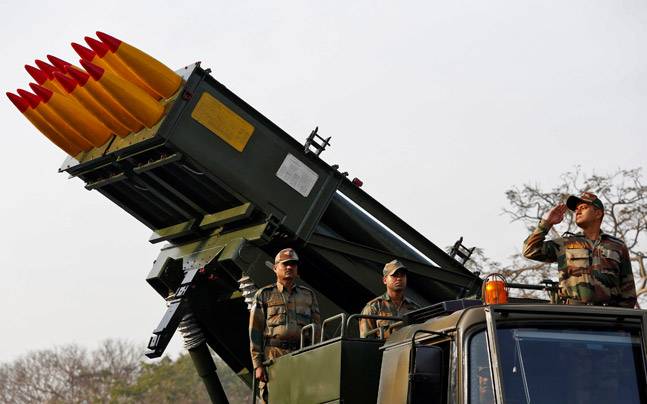
acquisition of long range vectors. The proposals for procurement of Tracked
Self Propelled Guns, BrahMos and Pinaka artillery systems are nearing fruition.
The induction of the indigenous artillery gun ‘Dhanush’ would also commence
post successful trials. Advanced munitions with improved precision and enhanced
destructive power are being procured.

Guns
Modernisation of Artillery has been on since
2012. Both global and indigenous routes are being adopted to hasten the
progress of modernisation. Major projects of 155 mm Towed Gun, Indigenously
developed 155 mm ‘Dhanush’ and 155 mm Tracked (SP) Gun are at final stages of
evaluation. Government has recently given a go ahead for the procurement of 155
mm Mounted Gun System. Upgunning of the existing 130 mm Guns to 155 mm/ 45 Cal
Gun System is also currently under progress as ‘Buy & Make Indian’.
Ammunitions
Bi-modular
Charge System (BMCS) is being procured through the Global and Indigenous route.
Indigenous capability in development and manufacturing of charge system is an
important step towards self-reliance. To this extent evaluation of the BMCS
produced by Ordnance Factory Nalanda has been completed. Electronic fuzes for
all calibers are being procured through revenue and capital route. A contract has been signed in January, 2016
for capital procurement of ammunitions for 84 MM Rocket Launcher with transfer
of technology for Ordnance Factory Board (OFB).
SATA Equipment
Self-reliance in production of Indigenous
Weapon Locating Radar (WLR) has been achieved and a contract for WLR signed in
December, 2015 is currently at an advance stage. To improve the accuracy of
Artillery fire, procurement of Inertial Navigation System (INS) too is being
undertaken.
Infantry
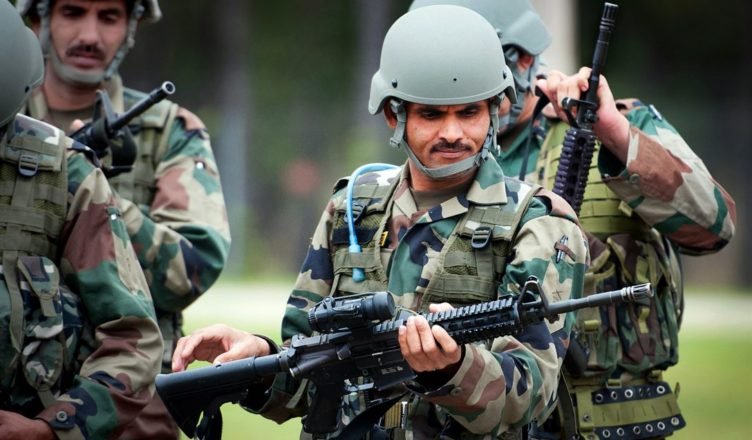
Modernisation of the infantry soldier is aimed
at enhancing lethality and providing individual protection. The proposals for
procurement of 3rd Generation Anti Tank Guided Missiles, Modern Ballistic
Helmets and Light Machine Guns are being progressed.
Army Air Defence
A contract
for the upgrades of L-70 guns has been concluded and that of Zu-23 guns is in
advanced stages of finalisation. The proposal for Medium Range Surface to Air
Missile Regiment (MRSAM), is also nearing fruition. In addition, schemes for
replacements of Short Range Surface to Air Missile systems, Successor for L-70
and Zu-23 Guns, Air Defence Fire Control Radar, Very Short Range Air Defence
System (VSHORADS), are in the pipeline.
Miscellaneous Equipment
In addition
to acquisitions specific to different arms, procurement and manufacture of
Reconnaissance and Surveillance HelicoptersKamov 226T, Air Cushion Vehicles,
Tactical Communication System, Material Handling Equipment and Critical Rolling
Stock for rail movement are in the pipeline. Modernisation of logistics
installations with state of the art warehousing facilities, retrieval and
accounting system is also underway. Much has also been achieved in exploiting
alternate and indigenous sources for procurement of HMVs (High Mobility
Vehicles) and Light Vehicles for the Indian Army.
Procurement of New Generation Rolling Stock for the
Indian Army
The Additional
Directorate General of Strategic Movement has started taking deliveries of new
generation rolling stock. These include specialist wagons for carriage of
military equipment and vehicles as well as coaches for conveyance of troops.
New generation AC-II, AC-III and Military Pantry coaches incorporate
modifications which make them efficient, feature rich and more comfortable.


No comments:
Post a Comment