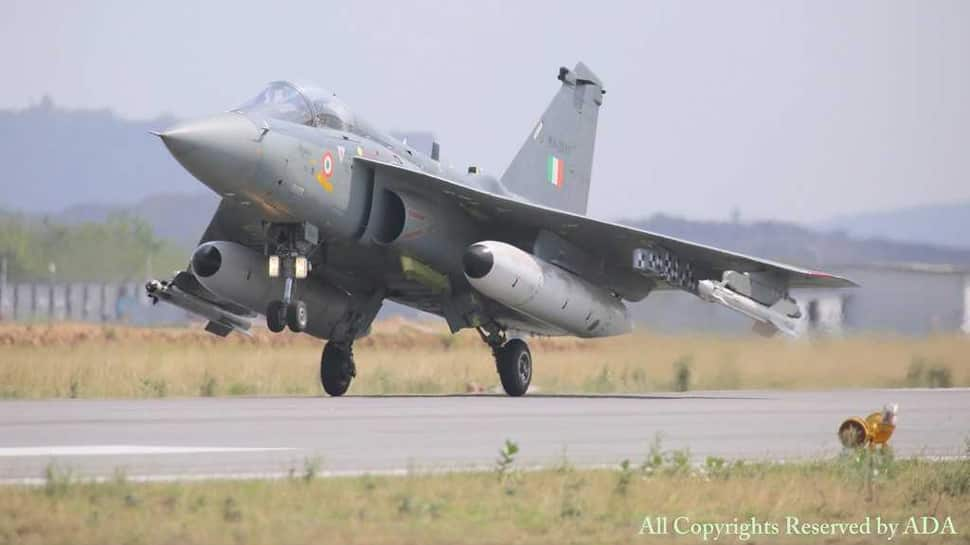
The Tejas is a single-engine multirole fighter which features a tailless, compound delta wing and is designed with "relaxed static stability" for enhanced manoeuvrability. The HAL Tejas is an Indian single-engine, delta wing, multirole light fighter designed by the Aeronautical Development Agency (ADA) and Hindustan Aeronautics Limited (HAL) for the Indian Air Force and Indian Navy.

HAL Tejas Mark 2 is being developed to meet the latest Indian Force Requirements and will incorporate fifth-generation jet fighters elements which are intended to make way into the Sukhoi/HAL Fifth Generation Fighter Aircraft (FGFA) and HAL Advanced Medium Combat Aircraft (AMCA).It is being developed for the use of Indian Air Force and Indian navy.
Specificatons
Specificatons
S.NO
|
Type
|
Parameter
|
|
1
|
Type
|
LCA MK1
|
LCA Mk2
|
2
|
Length
|
13.2 m
|
14.65 m
|
3
|
Height
|
4.4 m
|
4.86 m
|
4
|
Wingspan
|
8.2 m
|
8.5 m
|
5
|
Wing Area
|
38.4 m2
|
38.4 m2
|
6
|
Empty weight
|
7040 kg
|
7500* kg
|
7
|
Take-off Clean Weight
|
10300 kg
|
12,000* kg
|
8
|
Internal Fuel
|
2300 kg
|
3300 kg
|
9
|
Hard points
|
7 + 1
|
11
|
10
|
Max Take Off Weight
|
13,500 kg
|
17,500 kg
|
11
|
Max payload capacity
|
3910 kg
|
6300 kg
|
12
|
Engine
|
F404-IN20
|
F414-INS6
|
13
|
Max Thrust
|
84kN
|
98kN
|
14
|
Max Speed
|
1.6M
|
1.8M
|
15
|
G limits
|
+8/-3.5
|
+9/-3.2
|
16
|
Ferry Range
|
1750 km
|
3500 km
|
Origins
DRDO chief Dr S Christopher also confirmed that first Tejas MK2 will make its first flight by 2022 and will be ready to enter production by the time production run of 83 MK1A ordered by IAF comes to an end by 2025-26. In 1969, the Indian government accepted the recommendation by its Aeronautics Committee that Hindustan Aeronautics Limited (HAL) should design and develop a fighter aircraft around a proven engine. Based on a 'Tactical Air Support Aircraft' ASR markedly similar to that for the Marut, HAL completed design studies in 1975, but the project fell through due to inability to procure the selected "proven engine" from a foreign manufacturer and the IAF's requirement for an air superiority fighter with secondary air support and interdiction capability remained unfulfilled.
LCA programme
The MK2 is an improvement over LCA Airforce Mk1 with higher thrust engine. This aircraft will have improved survivability, maintainability and obsolescence mitigation. Active Electronically Scanned Array (AESA) Radar, Unified Electronic warfare Suite (UEWS) and On-Board Oxygen Generation System (OBOGS) are some of the state of the art technologies planned to be integrated. The cockpit design has been improved with bigger size, smart Multi function Displays (MFD) and smart Head Up Display (HUD).

Tejas parked next to F-16 Fighting Falcon (centre) and Eurofighter Typhoon (top) at 2009 Aero India A review committee was formed in May 1989, which reported that infrastructure, facilities and technologies in India had advanced sufficiently in most areas and that the project could be undertaken. A two-stage full-scale engineering development (FSED) process was opted for.In 1990, the design was finalised using the "control configured vehicle" concept to define a small tailless delta winged aircraft with relaxed static stability (RSS) for enhanced manoeuvrability.
Overview
The Tejas is a single-engine multirole fighter which features a tailless, compound delta wing and is designed with "relaxed static stability" for enhanced manoeuvrability. Originally intended to serve as an air superiority aircraft with a secondary ground-attack role, its flexibility permits a variety of guided air-to-surface and anti-shipping weapons to be integrated for multirole and multimission capabilities. The tailless, compound-delta planform is designed to be small and lightweight. This platform also minimises the control surfaces needed (no tailplanes or foreplanes, just a single vertical tailfin), permits carriage of a wider range of external stores, and confers better close-combat, high-speed, and high-alpha performance characteristics than comparable cruciform-wing designs. Extensive wind tunnel testing on scale models and complex computational fluid dynamics analyses have optimised the aerodynamic configuration for minimum supersonic drag, a low wing-loading, and high rates of roll and pitch.
Propulsion
Early on, it was decided to equip prototype aircraft with the General Electric F404-GE-F2J3 afterburning turbofan engine while a program to develop a domestic powerplant led by the Gas Turbine Research Establishment was launched. In 1998, after Indian nuclear tests, US sanctions blocked sales of the F404, leading to a greater emphasis on the domestic Kaveri. In 2004, General Electric was awarded a US$105 million contract for 17 uprated F404-GE-IN20 engines to power the eight pre-production LSP aircraft and two naval prototypes; deliveries began in 2006. In 2007, a follow-on order for 24 F404-IN20 engines to power the first operational Tejas squadron was issued.


No comments:
Post a Comment